Tag: news

  • AUDUSD Analysis

    TECH OUTLOOK-Daily chart

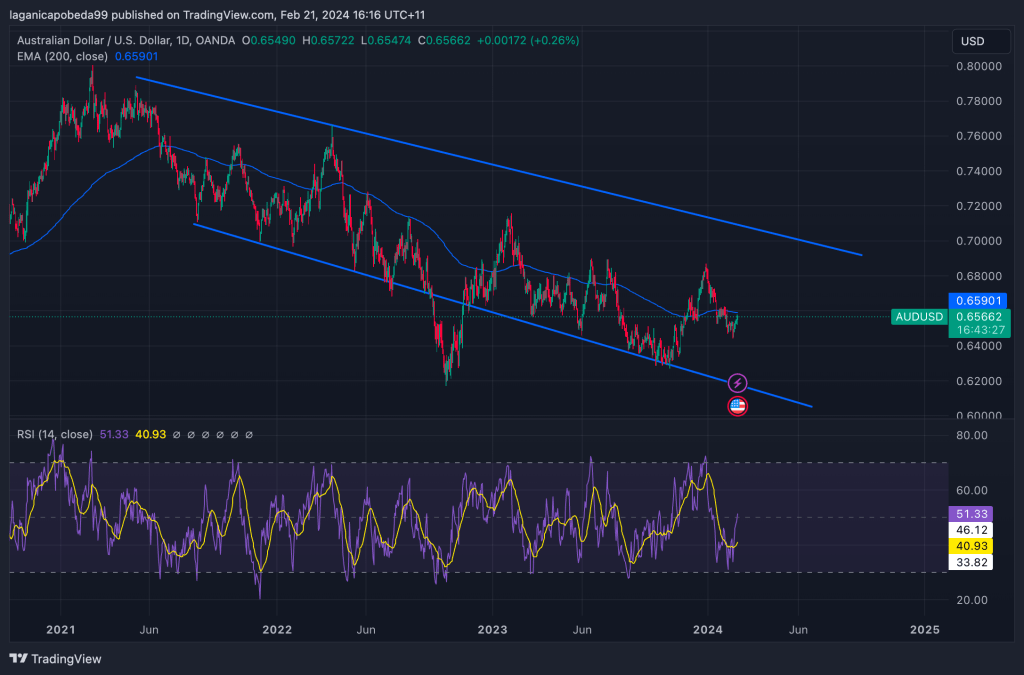
    AUDUSD has been floating around 0.63 to 0.7 range for the past few quarters now. Currently at 0.65 it’s at a steady pace towards the upside but still relatively weak compared to the previous years which averaged 0.75-0.85 . AUDUSD is just under the 200 day exponential moving average now and showing that it’s a good buying opportunity.RSI is at 40, under its 50 mark showing sold out conditions.
    FUNDY

    Currently the AUD has lower international buying power and is cheaper for foreigners to come to Australia and purchase its goods and services boosting export growth .

    Australian GDP has been sluggish , not fully going in line with the inflation rate which was around 7% in 2023 whilst the GDP rose September 2022 to September 2023 to 2.1% nominally.

    Current yearly CPI is at  4.9% whilst the cash rate at 4.35%.

    For America CPI is at 3.1%  , cash rates at 5.5%.

    ASX200 sitting at 7600 , just under its record high of 7700. Lowering the interest rates in the future for both FED and RBA will lift up the Stock Market even further up.

    US 10yr bond yields are up at 4.275% . Quarterly high was 5% and a low of 3.8% . 

    CALENDAR

    Chinese Central Bank has lowered its 5 year Lending rate by 25 basis points to 3.95% to assist with economic growth and stabilise the property market. This week the Feds meeting to see if they will lower rates , the speculation on the Street is that it will have to wait till June with 53% of surgery respondents sure that its going to be then. 

  • Argentina on crossroads

    Photo by Carolyn on Pexels.co

    Argentina has chosen a new president with revolutionary ideas to fix their chronic economic problems with inflation which currently hovers around 100% annually. The idea is to follow neoclassical economic principles of privatising assets and having a small government. The new Laissez Faire Incumbent president is facing his Perotist opposition which ran the country the past 19 years , it follows a more Socialist Keynesian principles of a bigger government role in managing the economy, but also one where inflation is rapid due to the governments financial budget solutions to cover rapid deficits with more money printing and debts. Which when accelerated causes high interest rates and run away inflation. It scares away foreign investors, causes deterioration of bond prices and local currency values . The challenge to change this system will be tough , as many government agencies employing thousands of people will need to be closed and the economic system rebooted to follow free market policies of Milton Friedman.At the start an economic shock usually follows with currency devaluation and a recession , but after a year or two the market corrects itself and goes into economic growth .

    Argentina is on the road not taken . How many developed countries do you know that have abolished their Central Banks ?- Not many.

    Questions remain .

    • Will this new economic idea bring an economic improvement?
      • Yes it will definitely invite foreign investment and free market capitalists inside the country that have been put off by the high taxes and government bureaucracy for a long time.
    • Will it make things even worse?
      • It really depends on how abruptly the new economic policies take place and will the vendors and consumers be able to adopt to the new conditions. Dollarisation will devalue the current currency and could cause medium term supply side inflation on the producers . Long term dollarisation could balance out the inflation since the gov central bank won’t issue its own currency anymore.
    • What about Argentinas Economic independence and their ability to have an independent monetary policy.
      • Well it will certainly will as they won’t issue their own currency anymore . They will use a foreign currency where that currency is tied to FED’s interest rates , which are based on the economic performance in the US, not Argentina. So if the latter ever finds it’s self in an economic crisis , it can’t issue and lend its currency to prop up the banks or lower the interest rates, its all going to be done on a limited supply of US dollar reserves held in the Argentine Central Bank and its Treasury . If there isn’t enough dollars to rescue the failing banks , we could be up for a major economic crisis where Keynesian policies are the only rescue .The result of the crisis all depends on the number of dollars available in the reserves.

    All these questions will be answered in a few years time when things unfold .But for now lets try to answer these questions ourselves and create assumptions.

    The economic policy of the new political hierarchy is Laissez Faire compared to the old Keynesian policies of propping up the country through public works and subsidies. The President elect Javier Milei wants to dollarise Argentina and make it the country’s official currency.It will a hard road as the country’s central bank doesn’t have enough dollars in its vaults to buy up all the dollars in the economy and convert them . Miles idea is to gradually phase out the pesos through 2 stages which will take years. Its for the economy to start pricing its goods and services in dollars ,then the Argentine Taxation Office will start collecting dollars in tax receipts and then slowly buy back the pesos from its citizens.The idea also encompasses a privatisation effort to sell government assets to shore dollars into the coffers of the Treasury and bring back Argentine offshore savings back the home nation. But for these ideas to all become true ,the new President has to convince the lower house to support his mad ideas where he only holds a 15% share . That’s not gonna be an easy task.

    Interesting Articles

    Milei’s Path to Dollarization: Riddled with Doubts

    Patrick Boyles analysis of the new Argentine presidents economic ideas