Blog

  • Australian Housing Unaffordability-Part 1

    Written in November 2022

    • Australian way of living is changing with inflation and the unaffordability crisis.
    • Young people have to work much longer to afford to buy a house whilst real wages inflation adjusted have actually fallen. 
    • Owning vs Renting?
    • Debt Servicing is becoming more expensive and is eating away families food budgets

    Gone are the days of Australia being the lucky country, Australian first homebuyers have to work twice as longer as their parents just to be able to afford their first home. In post lockdown Australia their wallets are getting over stretched with dictatorial government created inflation and the current global supply shock energy prices. The weather didnt help either ,La Nina caused flooding in the past 3 years has devastated many crops and created fresh food shortage across East Coast supermarkets.Petrol prices are normally hovering just above around $2 now days , increasing our daily cost of living.

    When you are meant to live closer to your work, young Australians are now buying further and further from their workplace,some even going 50km away and traveling for more than an hour each way , as it is all they can afford now.Many of them are trapped in this mirage of a dream family life , where they are expected to provide a good life for their families , but instead they are stuck in a debt trap,seeing their buying power shrink day by day, and having to work more hours to keep up with it all.

    Dont want to buy a home , should you rent one?

    Rent is dead money as everyone knows, if you are single this could be an easy option, one can get a place next to their workplace and share costs with a room mate. But what will happen when you get older and have spent hundreds of thousands of dollars on rent, when you could have used it as a first home buyer deposit.Today there is another problem in Australia , low vacancy rates which are hovering around 1% in Sydney at the moment.

    Australians are now having to compete with one another just to be able to find a place to live, with homelessnes at records all across the country.

    Income and Debt Servicing

    Nominally wages are rising every year , but when you put the price of housing ,fuel and basics into the equation , real time wages ticked lower.

    To succeed in life now days a young independent person needs a future proof strategy , depending that they stay healthy of course.

    An Average Gross Salary in Australia is around $80k , after tax that’s $60k.

    An average apartment in western Sydney costs around $500k , if you go into the more affluent neighbourhoods with a better lifestyle and closer to the beach your looking at something more expensive around $800k.

    Just to afford your first property which is 30km from the CBD , you will have to work around 10 years and using 100% of your earnings into mortgage repayments just to pay it all off. That’s if you exclude other costs such as starting a family, paying bills, sending money overseas to your family and even going on vacation. 

    But if you want to live in house , you will never even be able to afford it as an average house 30km from the centre costs around $1mill. 

    Basically unless your family helps you out and repays half your property off or if u don’t make a ton of money off bitcoin or by winning the lottery you will be working like a slave just to put a roof over your head. Stress is real .

    Now let’s not talk about petrol prices and the inflation ,especially the rising interest rates , ooh boy don’t go there.

    Mortgage interest rates are hovering around 5-6% , petrol over $2 a litre, record grocery prices at the shops, record house prices, even catching a train now days is expensive. 

    In reality all those crazies that have been saying the market will collapse and the dollar will collapse are all starting to look extremely smart , they’ve predicted it all. 

    Like the people that bought bitcoin for a couple of dollars as a joke and sold it later for tens of thousands of dollars each and became millionaires. 

    You really have to go against the tide to to come out as a winner.

    The smartest were the guys that went out in the rural areas and built environmentally friendly homes and installed solar panels on their rooftops , built their own creeks and own water wells and gardens with farm animals roaming around the farm .They are now enjoying a peaceful existence leaving off the land with free electricity. They can easily enjoy this inflationary crises by building another home on their lot and putting it on airbnb, let the dividends flow in .

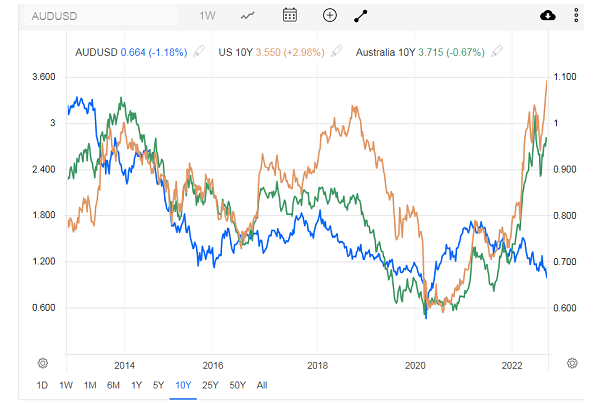
    AUDUSD is at record low at 0.62 as I’m writing this article. This week Reserve Bank of Australia lifted its rates by 25 basis points to 2.85 % , whilst the Federal Reserve in USA lifted their rates by 75 basis points , to 4% to fight off inflation.

  • Market update 14.10.2022

    • FED nowhere near pausing is market tightening
    • Stock indexes bounced back after higher CPI
      • CPI m/m 0.4% vs 0.1% previous
      • CPI y/y 8.2% vs 8.3% previous
      • Core CPI m/m 0.6% vs 0.6% previous
      • US unemployment claims 228k vs 219k previous
    • SP500 on the CPI news at NYSE Open release time from 3165 to 3500 in the first half an hour , then slowly retraced back to 3680 as the NY session closed
    • WTI hovered around $85-89 through the volatile session
      • Crude oil inventories 9.9 mil vs -1.4 m previous
      • Distillate Inventories -4.1 m vs -3.4m previous
      • Gasoline Inventories 2m vs -4.7m previous
      • Last weeks Baker Hughes Oil Rig Count 602
      • OPEC Lowering production

    British Pound has recovered to 1.13 against the greenback on the news that the UK budget might include lifting the corporate tax rate.Previously the Treasury and the new Prime Minister announced plans of an expansionary fiscal policy and tax rate cuts for higher income earners that drove the pound into a new low.

    30 year GILT went down 29 basis points to 4.52% . The plan originally was to keep corporate tax rate at 19% now they are planning to lift it to 25% next year.

    Truss plans to lower 45% tax rate for the highest income earners has been scrapped by the Chancellor Kwarteng as the tax cuts would creae a budget short fall. A recommendation by the Institute for Fiscal Studies has advised that the UK gov needs to raise rates by 62 billion pounds to fill the budget coffers.

  • Upcoming RBA interest rate decision

    Current rate is at 2.25% , predictions go from 25 to 50 basis points rises.

    Lets wait and see . Any rate rise will be welcome.

    WTI was up $85 from session low at the start of $81 on the light of the Wednesday OPEC meeting which is predicted to cause a 1million barrel a day cut , in the hopes to lift the prices up.

    Russia has vowed to stop sending oil exports to any country that set up oil price controls.

  • AUSTRALIAN DOLLAR HITS A NEW LOW

    The AUDUSD pair hit a low of 0.6580 before it went back to the 0.66 levels after FED Lifted its nominal interest rate from 2.5% to 3.25% to fight inflation which this year has been over 8% in the USA.


    This weakness in AUD has not been seen since April 2020 when the lockdowns and lowering of interest rates crashed the Australian Dollar.

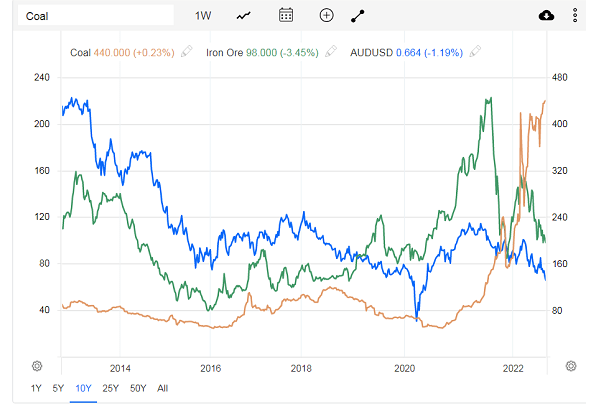
    When RBA held its interest rates were higher than the FED , AUD held its strenght but now that its interest are lower, the AUD is sinking to new lows . The only thing that saves the aud from sinking even lower are the high prices of export commodities.More than 75% of australian exports are minerals and metals, once that value goes down, AUDUSD could easily sink to new lows of 0.50 . Then the RBA would have to lift its interest rate even higher to keep the strenght of AUD .

  • UPCOMING – FED INTEREST RATE DECISION

    2PM EASTERN TIME , AEDT 10+ IS AT 4am .

    Expected 0.75 interest rate rise from 2.5% to 3.25% .

    Many analysts are saying that it could a 100 basis points rise.

  • Some notes from Jim Bianco’s guest interview at Macro Voices podcast

    MacroVoices #341 Jim Bianco: Inflation Is Not Going Away

    • The economic conditions and order around the world are changing because of high inflation, I created some notes from Jims latest guest interview.
    • Previous low inflation was based on the concept of cheap labour and immigration and low energy prices
    • After the lockdowns many office workers decided to work from home and many resigned from their jobs following the government pandemic handouts. Large swaths of workers are finding it easier to find higher paying jobs now days and the opportunity to work from home.
    • Wages in the developing world have also gone up especially in the manufacturing sector in China, to make matters worse the US restrictions on technological trade with China have helped in lifting the cost of hi-tech products coming from China.
    • Cheap natural gas to European manufacturing powerhouse has ended, with natural gas prices up 600% over the past year with the Ukraine – Russia conflict. High energy costs are bad for the manufacturing base as they raise the price of energy, which is the most important input into manufacturing a product.
    • Jim also forecasts prolonged inflation hovering around 4-5% for the next couple of years as the tight monetary policy won’t have much of an effect on lowering the inflation to the old levels of 2-3%. Gone are the days of cheap credit and easy monetary expansion.
    • The great resignation has created a profound change in the employment sector causing wide shortages of staff and a bottleneck in the supply of workers.
    • The current Ukraine – Russia conflict has shown us that now days energy commodities can be used as a political weapon in wars. Current weapon is natural gas, where any move from EU in sanctions results in higher gas prices and the natural gas supply pipes coming from Russia being turned off for Western Europe. This in turn causes big damage to their manufacturing sector as it loses out to cheaper competitors in other parts of the globe.
    • The current world is globalised , so any disruptions in energy supply can cause turmoil in the manufacturing sector
    • Inflation will be persistent in the future; it’s not going anywhere.

  • AUD-RBA Monetary Policy Meeting Minutes

    Link

    https://www.rba.gov.au/monetary-policy/rba-board-minutes/2022/2022-09-06.html

    AUD

    Members noted that high coal and gas prices were supporting Australia’s terms of trade at record levels. In contrast to other energy commodities, crude oil prices were well below their peaks following Russia’s invasion of Ukraine. This decline reflected concerns about the global outlook and improved supply. Even so, the price of crude oil remained about 20 per cent above the level at the beginning of 2022. Limited spare capacity and gas-to-oil substitution in Europe and elsewhere were likely to support crude oil prices in the period ahead. Base metals and food commodity prices had been fairly steady over the preceding month, but had declined from the peaks reached after Russia’s invasion of Ukraine.

  • Past week review 

    The previous week saw some interesting results: 

    USD 

    Inflation ticked higher in the USA with the monthly CPI higher at 0.1% and the core CPI (excluding food and energy) at 0.6%, the latter result highlights the fact that the core inflation has leached into everyday consumer products, signaling a need for another rate rise by FED to try to lower inflation. 

    Monthly PPI came out as –0.1% as the prices of fuel have been steadily going down the past 2 months from their peak, but when we exclude food and energy at the core PPI, we get a monthly rise of 0.4% as inflation has affected consumer products. Crude oil inventories have come in higher at 2.4million barrels than expected 1.9 mb, signaling a buildup of crude and further price stability in the $80’s. Philly FED Manufacturing index stood at –9.9 which is a sign of worsening conditions. Industrial capacity utilization is at 80% and industrial production is at monthly –0.2% vs previous months 0.5%. 

    Monthly retail sales are down 0.3% with unemployment claims falling to 213k from the previous 218k.University of Michigan’s preliminary survey on consumer sentiment came a little lower than expected at 59.5 vs exp 60, but still higher than the previous 58.2 signaling that consumers are still interested to spend more. 

     
    Central Bank interest rates 

    • CAD 3.00% 
    • NZD 2.50% 
    • USD 2.35% 
    • AUD 1.75% 
    • GBP 1.25% 
    • EUR -0.10% 
    • JPY -0.25% 
  • WTI

    Wti at $88-90

    Rising wedge through London signalled a reversal at London close as the day closed at euro and arab markets.

    US Crude oil inventories 2.4m vs expected 1.9.

    Previous was 8.8

  • CPI shock, turbulent markets

    Market Report for Wednesday 14th September 2022

    Last night the US released its CPI data as inflation edged higher for the August month at 8.3% y/y ,surprising analysts and signalling another rate rise.Analysts expected a lower reading of 8.1 % but that didnt happen.July inflation was at 8.5%.The markets are now pricing in a chance of 84% FED interest rate hike of 75 bps.

    Indexes all around the world are down, ASX200 fell 200 points from its overnight price of 7000 , to the Sydney Open price of 6800.

    SP500 is down to 2940 now from its highs of the release at 3150. Higher borrowing rates big tech conglomerates doesn’t bode well with the market. WTI stands at 87.5.

  • Market end report 30/08/2021

    ASX went sideways ,opening lower 30 points carrying the weekends rising covid cases (1200+) into negative territory. But at 1130am the economic calendar release for quarterly company profits came up with some positive n umbers of 7.1% rise to the expected 2.5% .

  • Gold fell from 1300 to 1290

    Thursday (April 11)

    • 8:30 US PPI. Estimate 0.3%. Actual 0.6%
    • 8:30 US Core PPI. Estimate 0.2%. Actual 0.3%
    • 8:30 US Unemployment Claims. Estimate 210K. Actual 196K
  • EURUSD 05April

    The euro has seen its optimism wane due to negative data today and the positive data coming from the US.

    eurusd

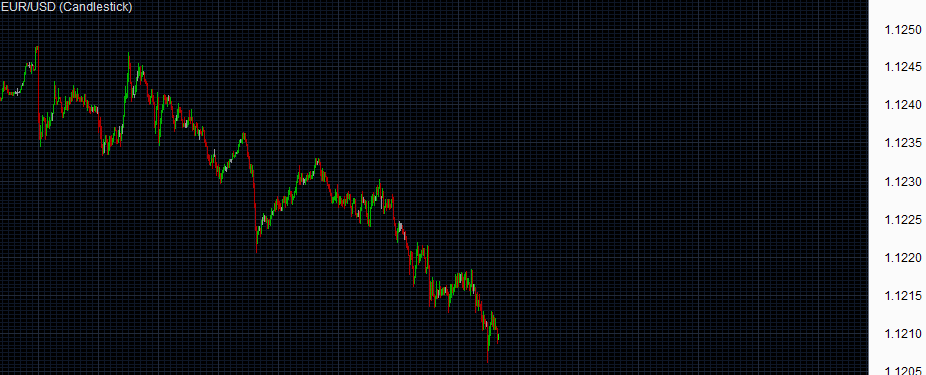
    The german factory orders plunged by 4.2% after its estimate of 0.3% failed to eventuate. The euro is trading at 12.09 from its high of the London session opening of 12.50.News oulets have reported growing optimism in the US-China trade talks with an estimated 90% completion rate. Whilst the chinese manufacturing PMI is posting a 14 month high, the german factory orders posted a 4 month in a row of contractory results.The german export oriented economy has been hit badly by the US-China trade war.

  • Have Trump’s tariffs had any effect on China?

    Chinas economy is rapidly expanding even after its US-Sino economic war with Donald Trump.

    That shows the strength and flexibility of the Chinese powerhouse .


    • China is a manufacturing powerhouse with Industry comprising over 40% of its GDP
    • Its people have moved all across the globe colonising different countries, following the old Colonialist model of creating demand for mother country’s products from overseas, this in turn generates jobs in China and improves the economies of both the mother country and the new countries
    • Millions of Chinese people have emigrated the country  , creating a purchasing force for its export oriented economy. Their numbers are growing and so is their influence on their new base countries to further develop better relations with China economically and politically
    • It’s manufactured products generally have an elastic demand as they are price dependent
    • Recently Chihas domestic industry has been producing high quality products duo to it’s high skills base of educated professionals.Their engineers design and build world class bridges,power plants and telecommunications tech around the world


    Trumps trade war did slow down Chinas economy but it’s still running strong and is expanding


    Asia


    • Chinas GDP quarter to quarter in January 2019 grew 1.5 % compared to the last Octobers 1.6% and 1.7% in July ,year on year in 2018 the GDP expanded by 6.6%  , which is the weakest pace from 1990
    • China’s 2018 trade surplus grew 9.9% to $351 Billion
    • Its unemployment rate is at 3.8% down from 4% , the same time in January 2018


    China’s industries are feeling the pinch of the trade war and effecting neighbouring economies


    • Japan’s exports to China in January fell by 17.4% year to year to $8.65Billion.It’s the second month of Decline from December’s drop of 7%.Chipmaking equipment exports to China fell the most by 25% , electronic circuits by 25% and chemical products and metals by around 10%.


    All this whilst Taiwanese exports to the US were up 21.2% last month .Many Chinese companies like Pegatron shifted production there.


    Even in South Korea the trade war is felt , with exports to China dropping by 14% on the year to $11.9 Billion.


    Samsung’s operating profit from the microchip business fell 29% to

    7.77 trillion won , as clients from  China have a dim view of the economy and are holding off further investments.

    Hyundai’s group operating profit fell 35% .Sales on their Chinese units fell to 221,000 as the trade war lowered the damand and the competition in China intensified. But overall Hyundai’s revenue has increased by 5% to 25.67 trillion won./.

  • Economic Indicators

    Economic Indicators

    From the book: The traders guide to Economic Indicators

    Economic indicators are very important in economic analysis because they can be used to predict future prices of currencies and forecast the economic and financial outlook for the nation’s economy.The mentioned indicators below are from the USA.

    Coincident Index (metric which shows the current state of economic activity within a particular area)

    • Number of Employees on non-agricultural (nonfarm) payrolls (in thousands)
    • Personal Income less transfer payments (nominal rate in Billions of chained 2005 dollars)
    • Industrial Production Index (2007=100)
    • Manufacturing and Trade Sales (in millions of chained 2005 dollars)


    Leading Index (a measurable economic factor that changes before the economy starts to follow a pattern or trend. Leading indicators are used to predict changes in the economy, but they are not always accurate., Investopedia definition)

    • Average Workweek, production workers, manufacturing
    • Average weekly initial claims for unemployment insurance
    • Manufacturers new orders for consumer goods and materials
    • ISM new orders index
    • Manufacturers new orders for non-defence capital goods (excluding aircraft)
    • Monthly building permits for new private housing
    • Stock prices
    • Leading Credit Index, M2 money supply prior to 1990
    • The interest rate spread between the 10-year Treasury bond and the Federal funds rate
    • Average Consumer expectations for economic conditions

    Lagging Index (is a measurable economic factor that changes only after the economy has begun to follow a particular pattern or trend.

    • Average duration of Unemployment
    • Ratio of manufacturing and trade inventories to sales
    • Manufacturing labour cost per unit of output
    • Average prime rate
    • Commercial and Industrial Loans outstanding
    • Ratio of consumer instalment credit to personal income
    • Changes in the consumer price index for services


    Sites

    • Employment:

    Bureau of Labor Statistics

    • Personal Income and Analysis

    Bureau of Economic Analysis

    • Industrial Production and Capacity Utilisation Report

    Federal Reserve Board

    • Manufacturing, Trade Inventories and Sales

    Department of Commerce

    • New Residents Construction Report

    US Department of Housing and Urban Development

    • Survey of Consumers

    Michigan’s Survey Research Centre

    • Manufacturing Business Report

    Institute for Supply Management

  • The Journey Begins

    Thanks for joining me!

    Good company in a journey makes the way seem shorter. — Izaak Walton

    post